Hartville, Ohio · Serving Stark and Summit County
Your books kept every month. Your numbers explained.
I'm Grant Brand, a financial analyst in Hartville. Every month I keep the books for small businesses around here: every transaction entered, every account reconciled, the month closed on a set date. Then I show you in plain English where you made money, where you lost it, and what to do next.
No sales deck. Tell me about your books and I send back a fixed monthly price within two business days. Then you decide.
What the numbers say
You billed $160,000 more this year and ended up $132,200 further behind.
Revenue grew 8.7%. Cash fell $47,200 and the line of credit rose $85,000. The shop financed the growth instead of being paid for it. Three things caused it, and all three are fixable.
Most small businesses don't need a CFO. They need books that are right every month, and someone to explain them.
Owner-run small businesses across Stark County, Summit County, and the Akron–Canton corridor: contractors, trades, shops, and service businesses. QuickBooks Online.
Sound familiar?
The money questions most owners can't answer on the spot
You don't know if last month made money.
The bank balance says one thing, the P&L says another, and neither one is up to date. You find out how the year went in April.
A busy month still leaves the account tight.
Revenue's up, cash isn't, and nobody can tell you exactly why.
The books are somebody's side job.
Your spouse, your office manager, or you at ten at night. Everyone's doing their best, and the books still fall behind.
Tax time turns into a cleanup project.
Nobody touches the books until February. Then your CPA sends back a list of questions and a bigger bill. For the other eleven months, the P&L is wrong and nobody's reading it anyway.
The gap
12 vs 1
Twelve closes a year instead of one. A lot of small businesses only see their real numbers at tax time, when it's too late to change them. Closing every month means you see a problem while you can still do something about it.
What I do every month
I keep the books, then I explain them
Most businesses your size have someone paying the bills and a CPA who sees the books once a year. Nobody owns the month. That's the job I do. I enter it, reconcile it, close it, and tell you what it means.
Keeping the books
- Enter and categorize every transaction from your bank and card feeds, plus the receipts and bills you send me.
- Reconcile every bank, credit card, and loan account to the statement.
- Keep the chart of accounts clean, and record payroll from your payroll company's reports.
- Close the month on a set date and produce the financial statements: profit and loss, balance sheet, and cash.
- A year-end package for your CPA by January 31: books they can file from and your banker can lend on.
Explaining them
- Your statements every month, with a few plain-English lines on what moved and why.
- Quick questions answered by email, any time of the month.
- With the Monthly Review: a one-page read on your month, like the sample below. What changed, why, and what to do about it.
- With the Monthly Review: a 30-minute call to talk through decisions (a quote, a hire, a piece of equipment, a customer you're not sure about) and one thing to fix, sized in dollars.
I don't do taxes and I don't run payroll. Your CPA keeps filing and your payroll company keeps paying people. I keep the books right in between, every month.
How it works
A fixed price up front. The same close date every month.
- Step 01
Your CPA introduces us, or you call me.
Ten minutes on the phone about your business and where your books stand today.
- Step 02
I look at your file and send a fixed quote.
A flat monthly price, plus a one-time cleanup if the books are behind. Within two business days, free.
- Step 03
Your books close on a set date.
You send statements and receipts by your monthly deadline. I do the rest and close the month a week later.
Clients give me accountant access to QuickBooks Online, the same access your CPA has. Never bank logins. A signed confidentiality agreement comes before anything else does.
What you get
This is the page. Every month, if you want it.
The Monthly Review adds a one-page read on your numbers, like this one for a fictional $2M machine shop. Every number on it is made up, but the shape is exactly what you'd get: what happened, what it cost you, and what fixing it is worth.
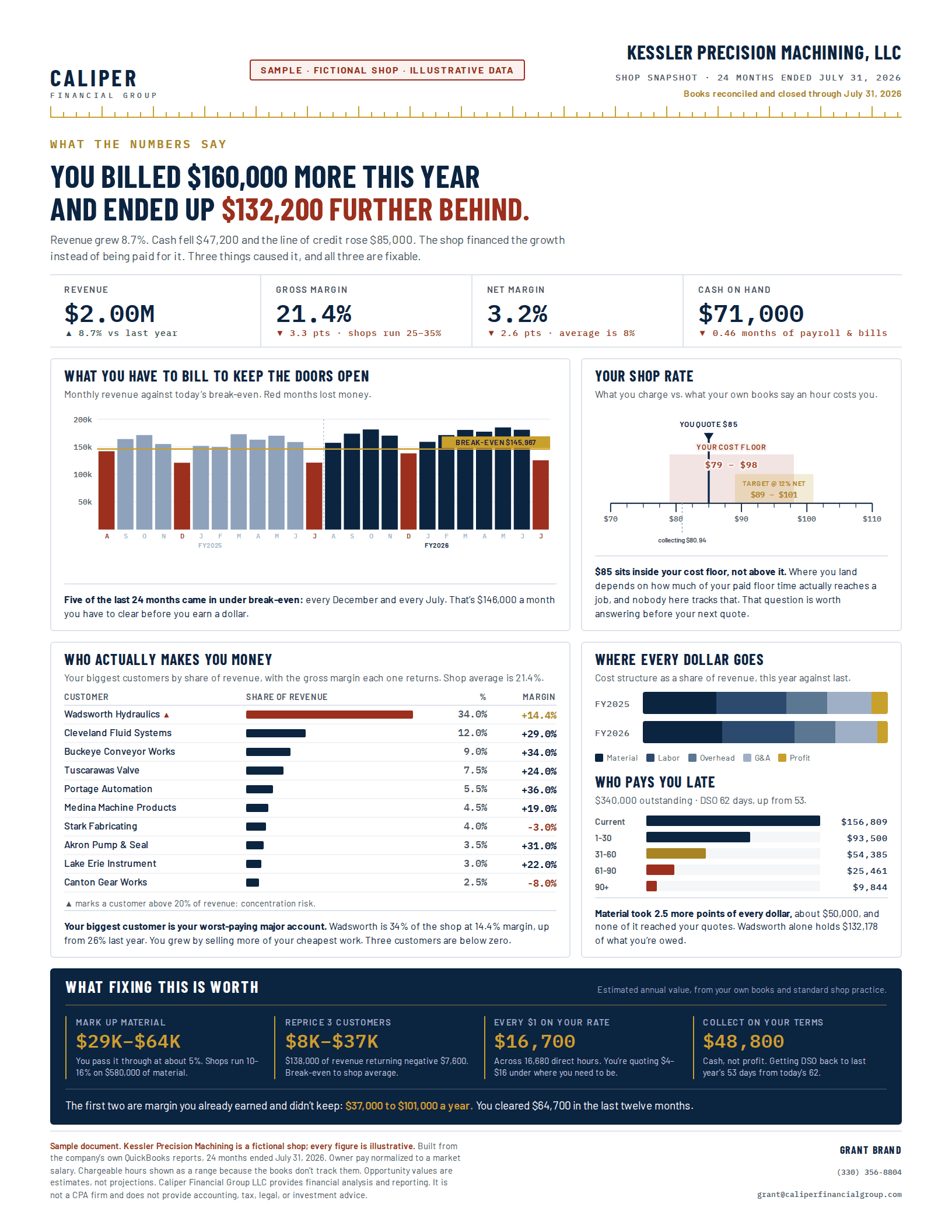
Kessler Precision Machining is fictional. Your page will have your business's name and your numbers.
Open the full sample (PDF) (opens in a new tab)What it costs
One flat monthly fee, set by how busy your books are.
Essentials
$350/month
Up to 75 transactions a month across 1 or 2 bank or card accounts, no payroll. Every transaction entered, every account reconciled, the month closed.
Ideal for: an owner-run business with simple books.
Standard
$550/month
76 to 200 transactions a month, up to 4 accounts, with payroll recorded and bills and invoices tracked in QuickBooks.
Ideal for: a business with a few employees and customers who pay on terms.
For busier books
Plus
5 or more accounts, job costing or inventory, and everything in the "What's included" section, every month.
Ideal for: a shop, contractor, or distributor that needs to know what each job made.
If the books are behind when we start, I catch them up first for 75% of your monthly fee per month behind, $500 minimum, quoted up front. No surprises on the invoice. A transaction is one line on a bank or card statement.
Add the Monthly Review to any tier for $100 a month: a one-page read on your month, a 30-minute call, and one thing to fix, sized in dollars.

Who you'd be working with
Reading a P&L is what I do for a living
I'm Grant Brand. I'm a financial analyst by trade. My day job is hospital finance: margin analysis, forecasting, and reporting for a health system where being wrong gets noticed. Before that I was the financial business partner for a game development studio in Green, running finance and operations. Before that I spent three years at Hartville Hardware, ending as a pricing and inventory specialist, which is where I learned what a quote looks like from the counter side.
I have a B.S. in Business Administration and Data Analysis from Liberty University. In every one of those seats, the job was reading someone else's numbers and telling them what the numbers mean.
Caliper exists because most small businesses around here only see their real numbers once a year, at tax time. Your CPA is buried from January to April. Whoever does the books is doing their best. The books sit there.
I'm not a CPA and I don't replace yours. Your CPA files your taxes and looks backward. I keep the books every month and look forward. The two jobs fit together; I'll be the easiest person your CPA has ever worked with.
Based in Hartville. I work remotely from your QuickBooks, and I'm glad to meet in person if you're within an hour of North Canton.
For CPAs
When your bookkeeper is full, send the next one to me
I keep monthly books for small businesses around Stark and Summit County. I don't do taxes and I'm not going to start. When your outside bookkeeper is full, or a client shows up every January with twelve months of uncategorized transactions, I'm the person you send them to. You get clean, reconciled books at year-end. Your client gets someone who answers the phone. Nobody's fees overlap.
- The client pays me directly by autopay. You never bill or chase anything.
- A year-end package by January 31: reconciled balance sheet, trial balance, loan and fixed asset schedules, and a list of open questions.
- I'm not a CPA and I stay in my lane: no tax, no attest, no advice on entity structure. Your client stays yours.
Fair questions
What owners usually ask
Yes. I enter and categorize every transaction from your bank and card feeds, plus the receipts and bills you send me. If someone already enters part of it, they can keep doing it and I'll check and finish the rest. Either way, the price is set by how busy the books are.
Your CPA files your taxes and looks at the year after it's over. I keep the books each month while you can still do something about it. Most CPAs are glad to have someone doing this, because it means clean books in January instead of a cleanup project.
For a quote, I only work from the reports you choose to send. For monthly work, you add me as an accountant user in QuickBooks, which is the same access your CPA has. Never bank logins. I sign a confidentiality agreement before you send me anything, and I'll tell you exactly where your files live and when they're deleted.
Then they're a mess, and that's most businesses. I'll tell you honestly how bad it is after I see the file, quote a one-time cleanup, and the monthly work starts once the foundation is solid. What I won't do is build a report on top of numbers I know are wrong.
No. Your payroll company runs payroll and files payroll taxes, and I record what they report. Your CPA files your returns. I make sure both of them are working from clean books.
Send your statements and receipts by your deadline: the 5th, 12th, or 19th, depending on the close cycle we pick together. Answer a few questions by email, usually about a transaction I can't place. Your books close a week later. If documents run more than three days late, the close moves to the next cycle and a $50 late fee applies, with the first one each year waived.